
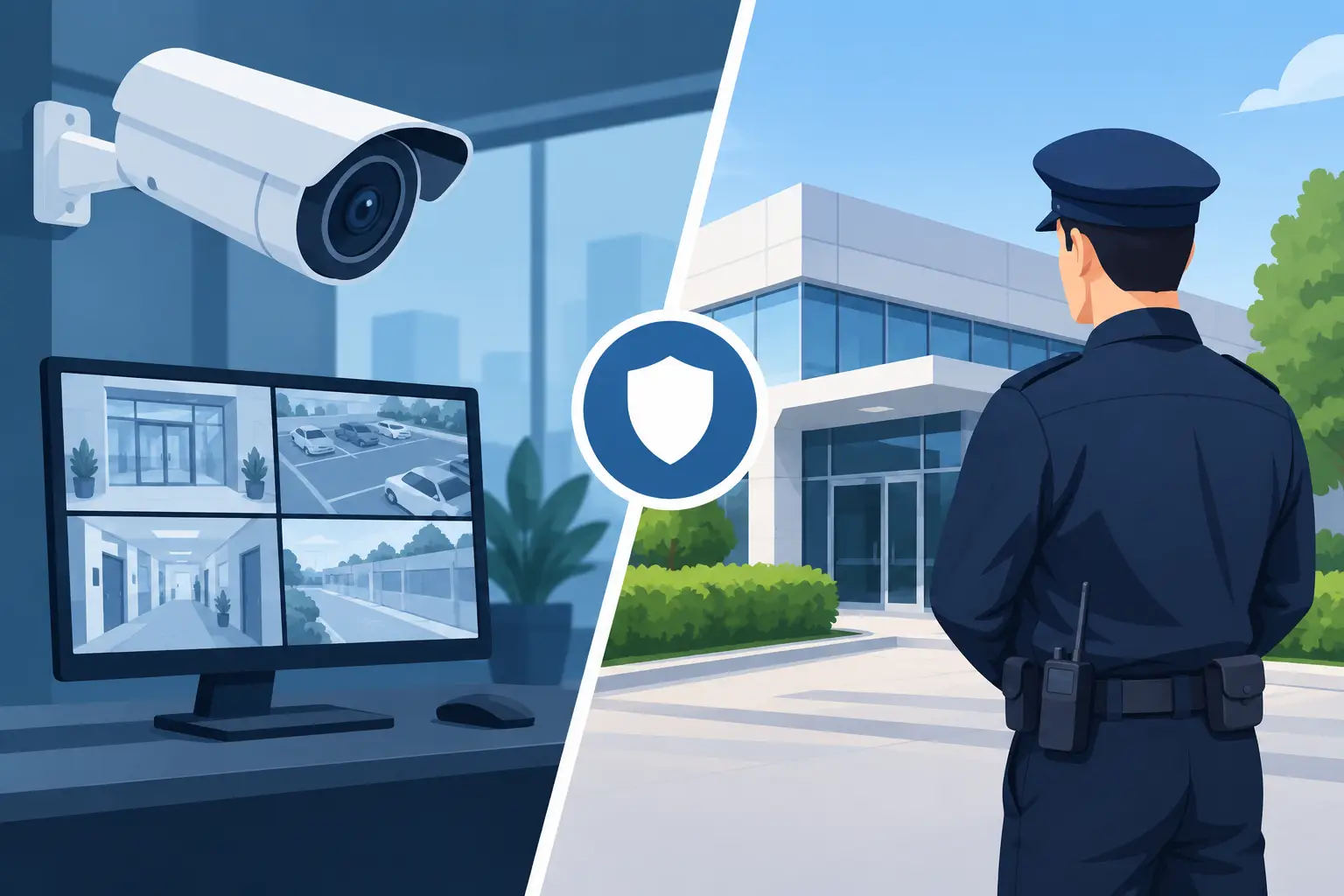
CCTV vs Security Guards: Which Suits Your Site?
A roller door left open after hours, an unfamiliar vehicle near a warehouse gate, or repeated damage in a car park all demand a practical response. When weighing up CCTV vs security guards, the best choice is rarely about selecting one option as universally better. It is about understanding the risks at your Perth property, how quickly an incident needs a physical response, and what level of coverage is sustainable over time.
For many homes and businesses, professionally designed CCTV provides reliable, around-the-clock visibility at a manageable cost. For higher-risk locations or periods of elevated activity, security guards can add a human presence that technology alone cannot provide. In some cases, the strongest result comes from using both strategically.
CCTV vs security guards: the core difference
CCTV records and displays what is happening at your premises. Modern systems can provide live viewing from a mobile, clear recorded footage, remote alerts and coverage across entrances, driveways, stock areas, reception spaces, loading bays and perimeter points. When designed correctly, cameras create a consistent record of activity, whether someone is on site or not.
Security guards provide a visible human presence. They can patrol, assess unusual behaviour, check doors and gates, assist authorised visitors, follow site procedures and escalate an incident in real time. Their value is greatest where judgement, direct communication or a physical response is required.
The trade-off is straightforward. CCTV can watch multiple areas continuously, retain evidence and operate every day without fatigue. A guard can interpret a situation and act within their authority, but can only be in one place at a time and involves ongoing staffing costs.
When CCTV is the better fit
CCTV is often the most practical first investment for homeowners, small businesses and sites that need broad, continuous oversight. A well-positioned camera system does more than capture a break-in after the event. Visible cameras can discourage opportunistic behaviour, help staff feel safer, and give owners and managers a clearer picture of what is occurring on site.
For a household, cameras at the front entry, side access, driveway and rear yard can help monitor visitors, deliveries and movement around the home. Remote viewing is useful when travelling, working late or checking on a property that is vacant. The goal is not to watch every moment of the day. It is to make key areas visible and ensure footage is available if something does happen.
For commercial and industrial premises, CCTV can cover areas that would be difficult for a single guard to patrol continuously. This may include several entry points, a large yard, staff car parks, stock cages, plant rooms, delivery areas and multiple buildings. Cameras can also support investigations into theft, vandalism, unauthorised access, workplace incidents or disputed deliveries.
Coverage that does not clock off
A camera system can monitor selected areas 24 hours a day. That matters when incidents occur outside business hours, during public holidays or in the short gap between a staff member leaving and an alarm being set. Cameras do not replace a response plan, but they provide visibility before, during and after an event.
The quality of that coverage depends on design. A low-cost camera pointed in the general direction of a gate may not capture a usable face, vehicle registration or the action taking place. Lens selection, mounting height, lighting, recording capacity, network reliability and camera placement all affect whether footage is genuinely useful.
Better long-term cost control
CCTV generally involves an upfront investment in equipment and professional installation, followed by maintenance and occasional upgrades. Over several years, that can be more predictable than paying for regular guarding shifts, particularly where the main need is monitoring rather than intervention.
Cost should not be measured only against the purchase price of cameras. Consider the value of reduced loss, evidence for insurance matters, fewer blind spots, staff reassurance and the ability to review incidents accurately. For multi-site organisations, an integrated CCTV platform can also help maintain consistent security standards across locations.
When security guards are the better fit
There are situations where a physical presence is the right answer. A guard may be appropriate for a construction site with valuable equipment, a busy event, a location experiencing repeated break-ins, a site with late-night staff or a premises where visitors need to be managed in person.
Unlike a camera, a guard can walk a perimeter, notice a damaged fence, speak with a contractor, direct a visitor to the correct area and respond to an immediate concern according to established procedures. This can be particularly valuable when the risk involves confrontation, crowd management or a fast-changing situation.
Guards can also provide reassurance in places where people are working alone or leaving late at night. However, their effectiveness relies on clear instructions, suitable staffing, patrol routines and communication with site management. A guard without a well-defined role can become an expensive presence rather than an effective security measure.
The limits of a human-only approach
A guard cannot observe every entrance, corridor and external boundary simultaneously. On a large industrial site, there may be long intervals between patrols in particular areas. A guard may also need to attend one issue while another occurs elsewhere.
This is where CCTV supports guarding operations. Cameras can provide oversight of key zones, record activity while a guard is occupied, and assist with verifying alarms or incidents. Footage can also help supervisors review events and refine patrol routes where recurring problems are identified.
Response matters as much as detection
One of the most common misunderstandings in security planning is expecting CCTV to physically stop an incident. Cameras are powerful deterrence and evidence tools, but they do not close a gate, challenge an intruder or attend a site by themselves.
A practical security plan answers a few questions before an incident occurs. Who receives an alert? Can they see what is happening? What action should they take? Is there an alarm, monitoring arrangement, on-call manager or guard patrol in place? How will police or emergency services be contacted if required?
For many Perth businesses, an integrated arrangement works well: CCTV provides visual verification, an intrusion alarm detects unauthorised entry, access control limits who can enter restricted areas, and a nominated response process determines the next action. This approach helps avoid relying on one measure to solve every problem.
How to choose for your property
Start with the risk, not the product. A family home may need clear evidence at entry points and simple mobile access. A retail store may need cameras focused on point-of-sale areas, stock rooms and customer entrances. A warehouse may need perimeter coverage, number plate visibility at gates and monitoring of high-value stock.
Then consider when the risk occurs. If concern is mainly after hours, CCTV and alarm integration may deliver stronger value than a full-time guard. If risk peaks during deliveries, events, shutdown periods or cash handling, temporary guarding may be justified alongside cameras.
It is also worth considering the operational burden. Camera systems need professional positioning, secure recording, regular checks and maintenance to remain dependable. Guards need rosters, clear site instructions and regular oversight. Neither option performs at its best when treated as a set-and-forget purchase.
Privacy is another important consideration. Cameras should be installed for legitimate security purposes, with sensible placement and appropriate handling of recorded footage. Avoid recording areas where people reasonably expect privacy, and ensure staff understand the purpose of workplace surveillance and relevant site policies.
Why a combined approach is often strongest
For higher-value or complex premises, CCTV and security guards are not opposing choices. Cameras give guards better situational awareness and extend visibility beyond patrol routes. Guards provide the human judgement and on-site action that cameras cannot.
A commercial complex, for example, may use cameras to monitor car parks, access points and common areas overnight, then arrange guard patrols during known high-risk periods. An industrial facility may use CCTV, alarms and access control every day, with guards deployed during construction works, major deliveries or temporary periods of increased risk.
The right balance should reflect your site layout, hours of operation, asset value and incident history. Securitec Security can help assess these factors and design a practical electronic security system that remains easy to use and support long after installation.
Security works best when it is planned before the next incident, not rushed after it. Whether your property needs continuous camera coverage, a visible patrol presence or a considered combination of both, the aim is the same: make your people, assets and premises harder to target and easier to protect.