
Protect Your Business with commercial security camera systems
When you think of commercial security cameras, it's easy to picture a grainy old monitor just waiting to catch a thief. But modern systems are so much more than that. They've become powerful tools for protecting your assets, sharpening up your operational safety, and even gathering vital business intelligence. For any business in Perth or across WA, a professionally designed camera system isn't just an expense—it's a core investment in protecting everything you've built.
Why Your WA Business Needs a Modern Security Strategy
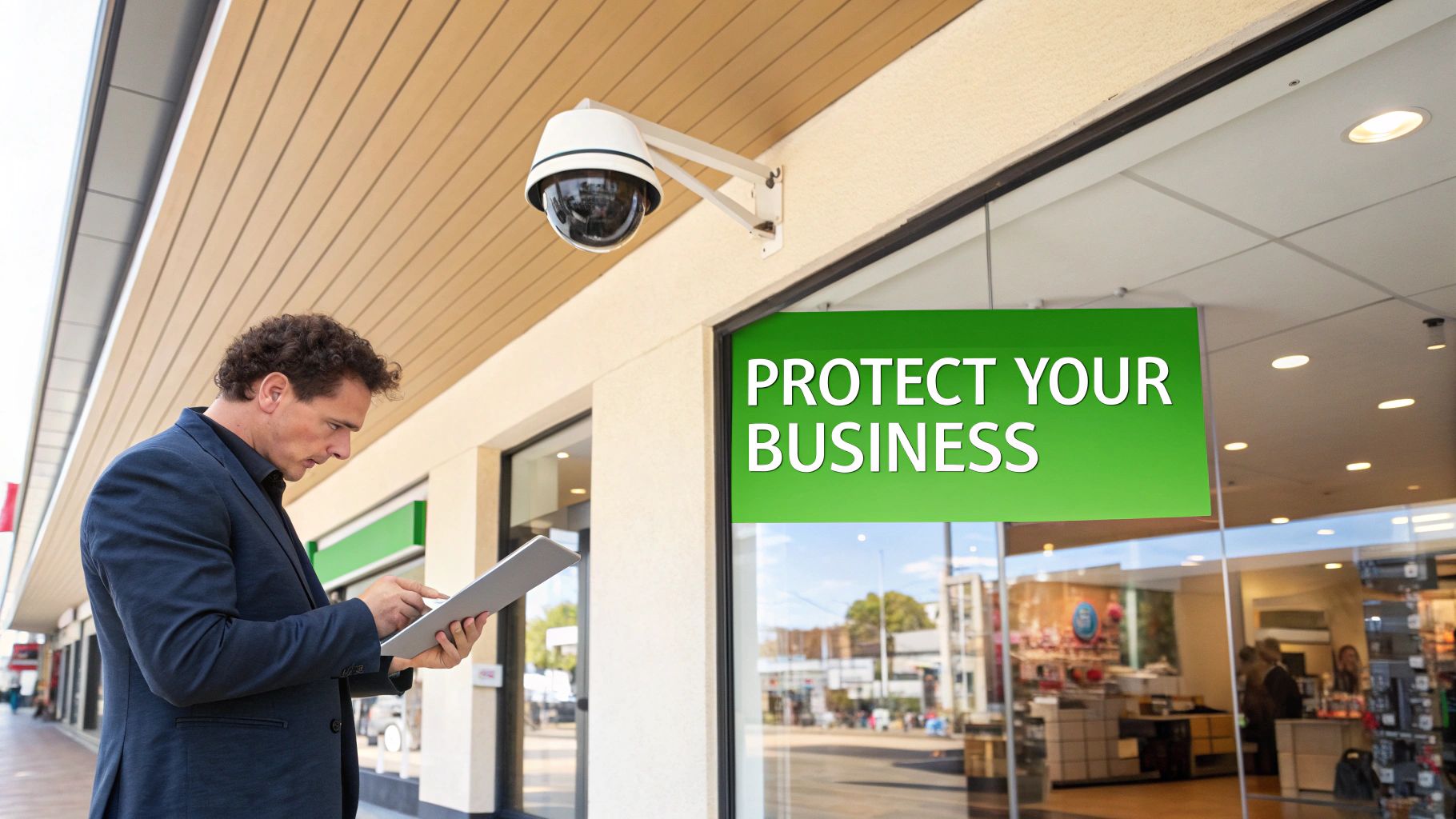
As a business owner or property manager, your priorities are clear: protect your physical assets, keep your staff safe, and ensure the doors stay open. A well-implemented commercial security camera system is an active part of making that happen. It’s a critical layer of defence against outside threats like burglary and vandalism, but it's just as important for handling internal issues like employee theft or fraudulent liability claims.
The jump to high-definition footage has been a game-changer. It’s the difference between seeing a blurry shape and a crystal-clear, identifiable face. That level of detail is absolutely vital when you need to conduct an investigation or provide solid evidence. Beyond that, the simple presence of visible, professionally installed cameras is a massive deterrent, often stopping an incident before it even begins.
More Than Just a Camera
Today's systems are less like standalone cameras and more like sophisticated networks with incredible functionality. They’re no longer just about catching criminals after the fact. Instead, they offer real-time insights that help you run your business more effectively. Think of them as your vigilant, round-the-clock digital watchmen, keeping an eye on critical areas so you can focus on everything else.
The applications stretch across every industry here in Western Australia:
- Retail Stores: Keep an eye on customer flow, deter shoplifters, and make sure staff are following safety protocols at the till.
- Offices and Corporate Buildings: Secure your entry points, protect server rooms holding sensitive data, and monitor any after-hours activity.
- Warehouses and Industrial Sites: Oversee large perimeters, track the movement of inventory, and ensure everyone is complying with occupational health and safety standards.
It's no surprise that the demand for these systems is growing fast. In fact, the Australia CCTV Camera Market hit a massive USD 914 million in 2023 and is set to keep climbing. This boom is especially noticeable in commercial sectors where businesses are investing heavily to safeguard their assets and make their operations smoother. You can read more about these Australian CCTV market trends to see where things are headed.
Choosing the right system isn't just a technical decision; it's a strategic business move. A reliable, compliant, and professionally installed system delivers peace of mind and a tangible return on investment by mitigating risks that could otherwise lead to significant financial loss. This guide is designed to give you the practical knowledge needed to make a smart, informed choice for your WA business.
Understanding Your Commercial Camera System Options
Before you can choose the right commercial security camera system, you need a handle on the core technology powering it all. The decisions you make at this stage influence everything from the clarity of your footage and the complexity of the installation to how easily your system can grow with your business. It's not about getting bogged down in specs, but about matching the right tools to your specific security challenges.
The biggest fork in the road for modern surveillance is between IP (Internet Protocol) and older analogue systems. A good way to think about it is like the difference between streaming a movie in brilliant 4K and watching an old, grainy videotape. Analogue cameras push video down a coaxial cable to a Digital Video Recorder (DVR), which often means lower resolution and very little flexibility.
IP cameras, however, are essentially powerful little computers. They capture crystal-clear, high-resolution video and send it as digital data over a network to a Network Video Recorder (NVR). This digital-first approach unlocks incredible image quality, opens the door to smart analytics, and makes integrating with other security systems a breeze.
IP Versus Analogue: A Clear Winner for Businesses
The industry has already made its choice, and the shift is undeniable. Commercial properties across Western Australia are embracing this change, with IP-based cameras now holding a dominant 47.92% revenue share in 2024. This move is largely driven by businesses in hospitality and logistics looking for better ways to fight shrinkage, especially as retail theft alone is costing Australian businesses over $4 billion every year.
While some large-scale sites are exploring wireless cellular options, for most commercial setups, IP is the undisputed standard. You can dig deeper into the data by exploring Australia's surveillance market trends to get the full picture.
To make it even clearer, let's break down the key differences between the two technologies.
IP vs Analogue Commercial Camera Systems at a Glance
This table sums up why modern businesses almost exclusively choose IP systems over outdated analogue technology.
| Feature | IP Camera Systems (Modern Standard) | Analogue Camera Systems (Legacy Technology) |
|---|---|---|
| Image Quality | Superior high-definition (HD) to 4K+ resolution, providing clear, usable evidence. | Lower standard-definition quality, making identification difficult. |
| Scalability | Easily expandable by adding more cameras to your existing network infrastructure. | Limited by the number of physical ports on the DVR, making expansion difficult. |
| Functionality | Supports advanced features like AI video analytics, remote access, and two-way audio. | Basic recording and viewing capabilities with very limited smart features. |
| Cabling | Often uses a single Ethernet cable for both power and data (PoE), simplifying installation. | Requires separate cables for power and video, increasing installation complexity and cost. |
As you can see, IP systems offer a future-proof foundation that analogue simply can't match in performance, intelligence, or scalability.
The Building Blocks of Your System
Beyond the core IP vs analogue debate, every professional security camera system is built from a few key components that work in harmony. Getting to know their roles helps you understand how a reliable and effective system is designed from the ground up.
1. The Cameras Themselves
Different cameras are built for different jobs. Using the right camera in the right place is crucial for effective coverage. The three most common types you’ll encounter are:
- Dome Cameras: Their discreet, dome-shaped housing makes it tough to tell where the lens is pointing, which is a fantastic deterrent. They’re also durable, making them perfect for indoor spots like offices, reception areas, or retail shop floors.
- Bullet Cameras: These are highly visible and instantly recognisable as security cameras. Their obvious presence makes them an excellent visual deterrent for outdoor areas like car parks, building perimeters, and loading bays.
- PTZ (Pan-Tilt-Zoom) Cameras: These cameras put you in the driver's seat. An operator can actively pan across a wide area, tilt up and down, and zoom in on specific details with incredible precision. They are ideal for actively monitoring large, open spaces like warehouses, public squares, or large car parks.
A well-designed system isn't about using just one type of camera; it's about a strategic mix. You might have a fixed bullet camera watching an entrance gate and a PTZ camera sweeping the entire car park. This ensures you have the right tool for every angle, leaving no blind spots.
2. Power and Connectivity
How your cameras get power and send back footage is a critical piece of the puzzle. For modern IP systems, Power over Ethernet (PoE) is the gold standard. This clever technology allows a single Ethernet cable to deliver both network data and electrical power to the camera. It dramatically simplifies wiring, reduces clutter, and ultimately lowers installation costs.
Of course, sometimes running a cable just isn't practical. For those tricky spots, wireless cameras offer great flexibility. They connect to your network over Wi-Fi and just need a nearby power source. While they're convenient, it's absolutely vital to have a strong, stable wireless signal. Any dropouts could create dangerous gaps in your security coverage.
Designing a Surveillance System for Your Property
You can't build an effective commercial security camera system by accident. Just bolting a few cameras to the wall is a surefire way to end up with glaring blind spots, fuzzy footage when you need it most, and a system that fails to deliver. A truly powerful and reliable setup is the result of a deliberate design process, one that starts long before a single piece of hardware is installed. This strategic approach ensures every camera has a clear job to do, perfectly matched to the unique risks and layout of your property.
It all begins with a thorough risk assessment. Put yourself in the shoes of a potential intruder or an opportunist. Where are the weak spots in your business? This means pinpointing the high-risk zones that demand constant eyes.
- Entrances and Exits: Every main door, loading bay, and fire escape is a critical choke point.
- Points of Sale: Cash registers and transaction counters are obvious targets for theft.
- Stockrooms and Inventory Areas: Keeping an eye on these spaces is key to preventing both internal shrinkage and external theft.
- Car Parks and Perimeters: Often your first line of defence, protecting vehicles and monitoring your property's boundaries is crucial.
Once you know what you need to protect, you can start mapping out the specifics of your camera layout and the tech required to do the job right.
Achieving Complete Coverage and Clarity
The real goal of camera placement is to create overlapping fields of view that leave zero blind spots. This doesn’t mean plastering every surface with cameras; it’s about positioning them smartly to cover the high-risk areas you've already identified. A camera watching an entrance, for instance, should capture the immediate approach, not just the doorway itself.
This diagram shows the basic flow of how a camera connects to a recorder, which is the rock-solid foundation of a modern IP surveillance system.
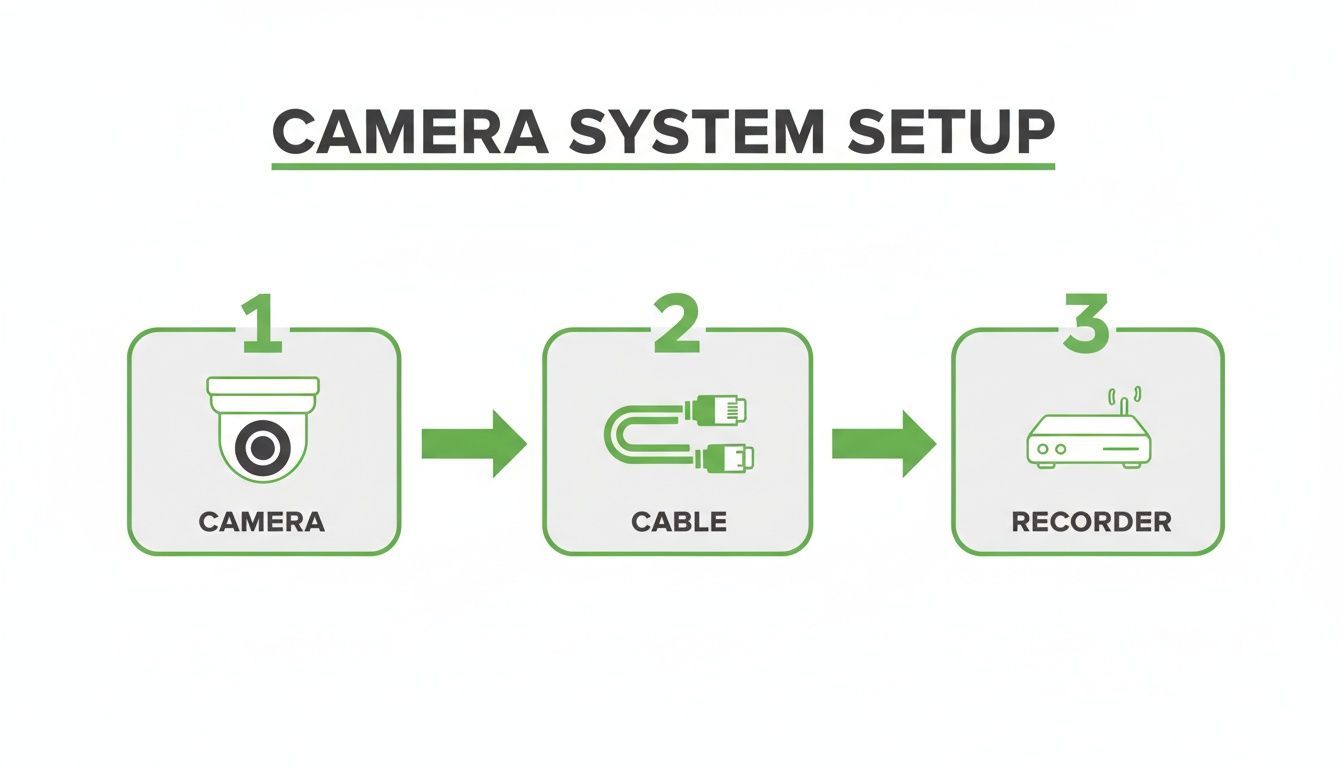
This simple process highlights why a physical, cabled connection to a central recorder remains the most reliable setup for any serious commercial application.
Beyond just where you put them, several technical details will make or break your system's effectiveness.
1. Resolution Matters—but It Has Trade-Offs
High resolution like 4K delivers incredibly sharp, detailed images, making it far easier to identify faces or read a licence plate. But that clarity comes at a price. Higher resolution footage chews through storage space and demands more network bandwidth. A smart strategy is to deploy 4K cameras at critical chokepoints—think entrances and cash registers—while using more cost-effective 1080p or 2K cameras for broader, less critical zones.
2. Frame Rate for Smooth Motion
Frame rate, measured in frames per second (fps), dictates how fluidly motion is captured. For reference, standard TV runs at 25-30 fps, which gives you that smooth, natural look. For most commercial security needs, 15-20 fps is perfectly adequate to capture clear evidence without creating massive file sizes. But in fast-paced environments like a busy loading dock or a high-traffic retail aisle, bumping that up to 30 fps might be necessary to avoid getting choppy, unusable footage.
A well-designed system balances these factors. A Perth CBD office might prioritise 4K resolution at its reception desk to capture clear facial details, whereas a large Canning Vale warehouse may opt for a slightly lower resolution but wider coverage to monitor large floor areas efficiently.
Using Technology to Overcome Challenges
Modern cameras are packed with features designed to handle tough, real-world conditions. Wide Dynamic Range (WDR) is a fantastic example. It's a technology that brilliantly balances the light and dark areas within a single frame. Picture a camera pointed at a glass entryway on a bright Perth day. Without WDR, anyone walking in would be a dark silhouette against the blinding sun. WDR processes the image to make both the bright outside and the darker interior clearly visible.
Nighttime performance is another game-changer. Cameras equipped with advanced infrared (IR) illuminators can literally see in complete darkness, producing crisp black-and-white images. For any business operating 24/7 or needing to secure its premises after hours, strong IR capability isn't just a nice-to-have; it's non-negotiable.
Turning Cameras into Proactive Tools
The biggest shift in modern commercial security camera systems is the move away from just passively recording events. Today, it’s all about proactive intelligence. This is done with video analytics—smart algorithms that automatically analyse video feeds for specific events. Instead of a security guard having to stare at hours of uneventful footage, the system can send an instant alert when something important actually happens.
Here are a couple of common analytics that deliver huge value:
- Line-Crossing Detection: This feature lets you draw a virtual tripwire in the camera’s view. If a person or vehicle crosses that predefined line, it can trigger an alarm, ping your phone with a notification, or start recording at a higher quality. It’s perfect for securing a perimeter after hours.
- Intrusion Detection: You can define a specific zone, like a secure stockroom or around a server rack. If motion is detected inside that box, an alert is generated, giving you an immediate heads-up about a potential breach.
By thoughtfully designing your system around risks, coverage needs, and these kinds of smart features, you transform your cameras from a simple recording device into an active, intelligent security asset.
Navigating Security Laws and Compliance in WA
Putting a commercial security camera system in place is about more than just technology—it's a legal responsibility. Here in Western Australia, your surveillance activities are shaped by specific laws that strike a balance between your security needs and individual privacy. Getting this wrong isn't just a misstep; it's a serious business risk that can lead to legal penalties and tarnish your reputation.
The key piece of legislation to get your head around is the Surveillance Devices Act 1998 (WA). This Act draws clear lines in the sand about how you can record video and, crucially, audio. Ignorance is no excuse, so understanding these rules is non-negotiable.
A properly designed system doesn't just protect your property. It also respects legal and ethical boundaries, which is fundamental to building trust with your staff and customers.
The Golden Rules of Surveillance in WA
While the legislation has its complexities, compliance for most businesses comes down to a few core principles. The biggest one? Audio recording.
It is illegal to record a private conversation if you aren't part of it, unless you have consent from everyone involved. In simple terms, this means your security cameras should almost never be recording audio in places where people expect their conversations to be private.
Transparency is the other cornerstone of compliance. You must be upfront that cameras are rolling.
This means you need to have:
- Prominent Signage: It's mandatory to place clear, visible signs at every entrance. These signs must state that CCTV cameras are in operation. No exceptions.
- Employee Notification: Your team needs to be officially informed about the cameras—where they are and why they’re there. This should be clearly documented in your workplace policies.
Failing to give proper notice is a direct breach of privacy principles. The whole point is to make sure anyone on your premises knows they are being recorded, removing any expectation of privacy in the areas you monitor.
Why Professional Licensing Is Non-Negotiable
This is where your choice of installer becomes absolutely critical. In Western Australia, anyone installing security systems must hold a valid Security Agent License and have a police clearance. This isn't just bureaucratic red tape; it’s your guarantee that the person setting up your system actually understands the complex legal landscape.
A licensed professional will:
- Ensure Legal Compliance: They know how to design a system that sticks to the Surveillance Devices Act, like making sure audio recording is disabled where it's not allowed.
- Provide Expert Guidance: They’ll advise you on the correct placement for signage and help you create clear internal policies for your employees.
- Uphold Ethical Standards: A true professional respects privacy and will configure your system to avoid monitoring sensitive areas like bathrooms, change rooms, or staff break areas.
Hiring an unlicensed or inexperienced installer exposes your business to huge risks. A system that illegally records audio or is installed without the right signage could mean your footage is useless as evidence in court. Worse, it could open you up to serious legal challenges. For a deeper dive into responsible data handling, you can learn more about privacy policies and their importance.
Ultimately, understanding WA's security laws isn't just a box to tick—it’s a fundamental part of implementing a commercial security camera system. Working with a licensed, police-cleared expert is the only way to be sure your investment protects your business effectively, ethically, and legally.
Creating a Fully Integrated Security Ecosystem
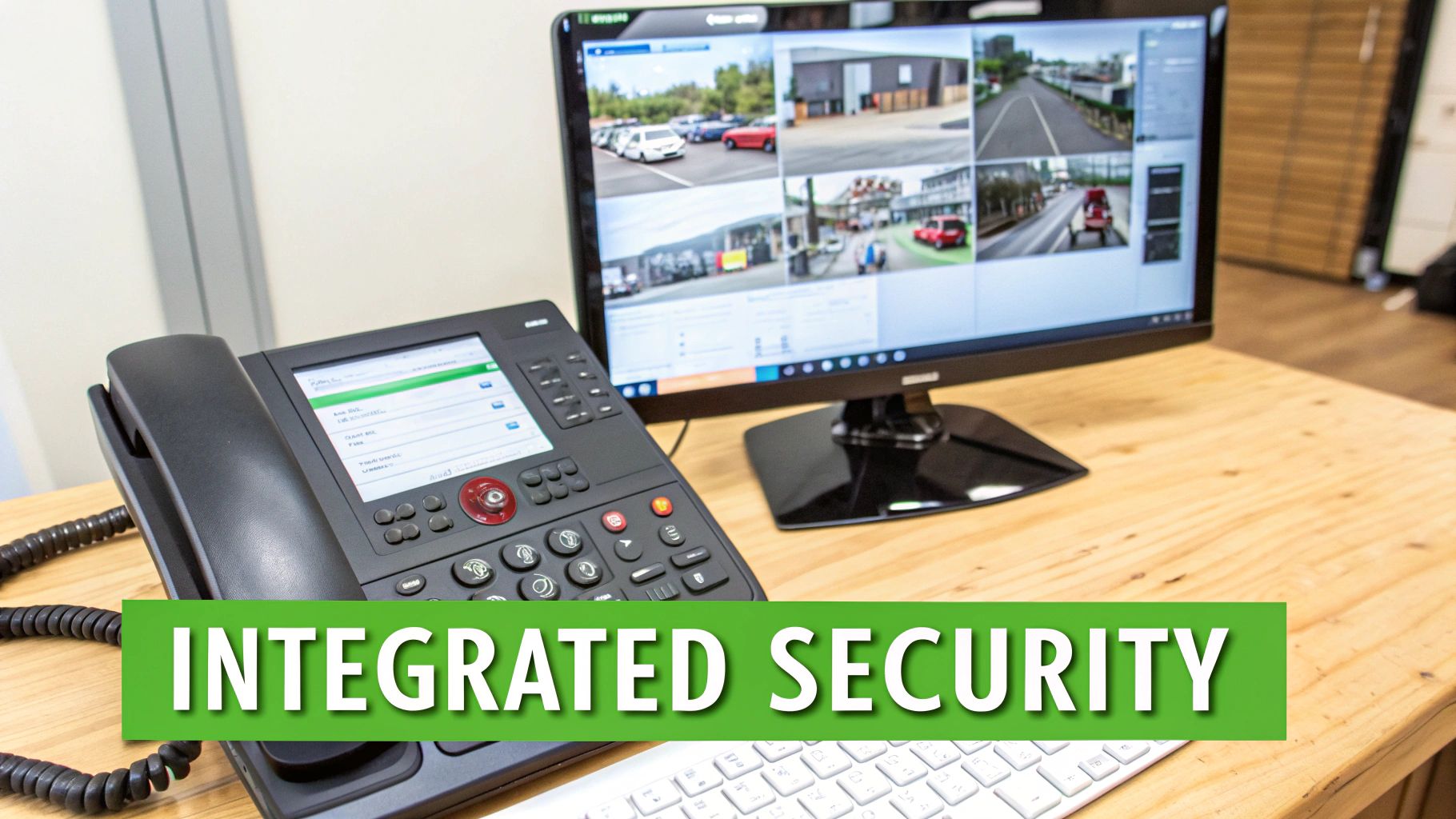
A standalone commercial security camera system is a powerful tool, but its real value is unlocked when it becomes the central hub of a connected security ecosystem. Instead of having separate, siloed systems, integration creates a unified fortress where each part makes the others smarter and more effective. It's the difference between reactive monitoring and proactive, automated security that works as a single, intelligent unit.
Think about it this way: an intruder alarm is tripped on your property's perimeter after hours. A standalone system would just make a lot of noise. But an integrated one springs into action. The alarm trigger instantly tells specific cameras to pan, tilt, and zoom to the exact breach point, start recording in high definition, and send a live video clip straight to your phone. This immediate visual verification is the difference between a loud noise and actionable intelligence.
This synergy completely transforms how you protect your business, providing a level of operational control and security that isolated devices just can't match. It’s all about making your security components talk to each other to create a response that is far greater than the sum of its parts.
Combining Video with Access Control
One of the most valuable integrations is linking your CCTV system with your access control. When an employee or visitor swipes a card or enters a code at a restricted door, the system doesn’t just grant or deny access—it logs the event with a corresponding video clip.
This creates a bulletproof audit trail. If a question ever comes up about who entered a sensitive area like a server room or cash office, you can instantly pull the video footage linked to that specific access event. It removes all doubt and provides indisputable visual confirmation, which is absolutely essential for investigations and maintaining tight control over your facility.
Strengthening Entry Points with Video Intercoms
Video intercoms add another critical layer of integrated security, especially for main entrances and delivery gates. When a visitor presses the button, you don’t just hear their voice; you see them in clear, high-definition video on a monitor or even your smartphone.
This allows you to visually verify their identity before remotely granting access from wherever you are. The best systems will also automatically record a short video clip of every interaction at the intercom, ensuring you have a complete visual record of every person who has requested entry. It’s a simple but incredibly effective way to manage visitor access with total confidence.
An integrated system centralises management onto a single, user-friendly platform. Instead of juggling multiple apps or dashboards for your cameras, alarms, and access control, you can monitor and manage everything from one place, saving time and reducing complexity.
The Power of a Unified Security Network
The push towards integrated solutions is a major factor behind the growth of the Australian security market. Driven by strong demand in retail and logistics, the national CCTV market hit USD 0.91 billion in 2023. Commercial spaces now make up over 25% of this demand, partly because these integrated networks are just so effective. This trend is amplified by safety programs that have helped slash crime by up to 30% in monitored zones. For more details, you can explore the latest Australian CCTV camera market report.
Ultimately, creating an integrated ecosystem multiplies the value of your initial investment. By connecting these systems, you build a smarter, more responsive, and efficient security operation that offers unparalleled protection. You can learn more about designing these types of advanced business security solutions in our guide to commercial security systems.
Choosing the Right Security Installer in Perth
Your investment in a commercial security camera system is only as good as the hands that install it. Let's be frank: the most advanced cameras on the market won't protect your business if they're poorly positioned, incorrectly configured, or installed with sloppy workmanship.
Choosing the right security partner in Perth is the final, crucial step. It’s what transforms your security plan from an idea on paper into a reliable asset that actually works when you need it.
This decision goes way beyond finding someone to run a few cables. You’re picking a long-term partner responsible for safeguarding your property, your staff, and your livelihood. A cheap, off-the-shelf solution installed by an unqualified technician almost always leads to much higher costs down the road—think system failures, security breaches, and compliance headaches.
What to Look for in a Security Partner
Not all installers are created equal. A genuinely professional security provider proves their expertise and trustworthiness through verifiable credentials and a solid track record.
Here’s a simple checklist to guide you:
- Proper Licensing: The installer must hold a valid WA Security Agent License. This is non-negotiable and confirms they meet the state's legal requirements.
- Police Clearance: Every technician setting foot on your property should have a current police clearance. This gives you complete peace of mind.
- Proven Local Experience: Look for a company with years of experience protecting businesses specifically in Perth and WA. They’ll understand our unique challenges and local regulations.
- High-Quality Components: A reputable installer will recommend and use commercial-grade equipment from trusted brands, not flimsy consumer kits known for their high failure rate.
An experienced installer does more than just mount cameras. They provide a full consultation, conduct a detailed site assessment to identify vulnerabilities, and design a system that delivers a genuine return on investment.
From Cost to Long-Term Investment
It’s easy to see security as a grudge purchase, but a professionally designed and installed system is a powerful business investment. The Return on Investment (ROI) isn’t just about stopping theft; it delivers tangible financial and operational benefits across the board.
A well-executed system helps by:
- Reducing Theft and Shrinkage: Directly protecting your inventory and assets from both internal and external threats.
- Potentially Lowering Insurance Premiums: Many insurers offer reduced rates for businesses with professionally monitored security.
- Enhancing Staff Safety: Creating a safer working environment and deterring workplace incidents.
- Providing Invaluable Peace of Mind: Knowing your business is protected 24/7 by a reliable, compliant system.
The difference between professional workmanship and a rushed job is obvious. Neat, secure cabling, optimal camera placement for clear sightlines, and thorough system configuration are the hallmarks of quality. By contrast, messy wiring and poorly aimed cameras are just signs of future problems.
If you're considering a new installation, our comprehensive guide on CCTV installation in Perth provides more detailed insights.
Ultimately, picking the right installer ensures your commercial security camera system performs flawlessly when you need it most, turning a necessary expense into a smart, protective investment for your business's future.
Frequently Asked Questions
When you're looking into commercial security cameras, a lot of questions pop up. Getting clear, straightforward answers is the key to feeling confident about your investment and making sure the system you end up with is the right fit for your business. Here are a few of the most common queries we hear from business owners across Perth.
The idea here is to give you practical insights that cut through the jargon and help you understand what a professionally designed security setup can actually do for you.
How Much Storage Do I Need for My Commercial Cameras?
This is a great question, and the answer isn't a simple one-size-fits-all number. It really comes down to a calculation based on four key things: the number of cameras you have, the recording resolution (like 1080p vs 4K), the frame rate you're capturing, and how long you need to keep the footage—your retention period. For example, many businesses need to hold onto recordings for at least 30 days.
A single 4K camera will chew through storage much faster than a standard 1080p one. That’s why a professional installer will do the maths for you. They’ll work out exactly how much storage you need so you’re not paying for a massive hard drive you’ll never fill, but you'll definitely have enough space to meet your compliance needs. Your main options are either an on-site Network Video Recorder (NVR) with expandable hard drives or a secure cloud-based solution.
Can I View My Business Cameras Remotely on My Phone?
Yes, absolutely. Secure remote access is a non-negotiable feature in any modern, professional security camera system. These IP-based systems are built from the ground up to let you check in on live feeds, watch recorded footage, and get instant motion alerts right on your phone, tablet, or computer.
It all works through a dedicated, secure app. A professional installer’s job is to make sure this connection is locked down tight to keep anyone unauthorised out of your network. They’ll also give you a full run-through so you feel completely comfortable managing your system from anywhere in the world.
What's the Difference Between a Commercial System and a DIY Kit?
The difference is night and day, and it all boils down to reliability, performance, and whether you're meeting your legal obligations. Commercial-grade systems are built tough, using higher-quality components designed to run flawlessly 24/7 in busy, demanding environments. They give you far superior image clarity, access to advanced AI analytics, and are designed to grow with your business.
Crucially, professional systems are designed for seamless integration with other security components like alarms and access control, creating a unified security ecosystem. DIY kits from a hardware store are often less reliable, have very limited features, offer minimal to no support, and may not comply with WA’s stringent commercial surveillance laws. Professional installation also guarantees that cameras are optimally placed and correctly configured for maximum effectiveness, an expertise you simply don't get out of a box.
Ready to secure your business with a system designed for your specific needs? The team at Securitec Security has over 30 years of experience protecting commercial properties across Perth. Request a quote online or call us for an expert consultation.
Generated with Outrank app