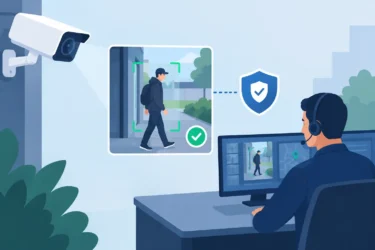
AI Video Surveillance Trends for Perth Sites

A camera notification at 2.15 am is only useful if it tells you something worth acting on. For Perth homes, worksites, warehouses and retail premises, AI video surveillance trends are shifting CCTV from passive recording towards practical, event-based security monitoring. The value is not in adding more alerts. It is in helping the right person see relevant activity sooner, while keeping a clear record of what occurred.
Why AI is changing video surveillance
Conventional CCTV remains an essential security tool. It deters opportunistic crime, provides visual evidence and lets owners or managers check on a property remotely. Its limitation is scale. A busy site can generate hours of footage and a basic motion alert can be triggered by headlights, rain, tree movement, animals or passing traffic.
AI-enabled analytics add context to that footage. Rather than responding to every movement, a correctly configured system can identify categories of activity such as a person entering a restricted zone, a vehicle approaching a gate, an object left near an entrance, or a crowd forming where it should not. This helps reduce unnecessary notifications and allows staff to focus on events that may need attention.
The technology is especially useful when it supports a clear security plan. AI is not a replacement for good camera placement, adequate lighting, reliable recording or professional maintenance. It is an additional layer that makes those foundations more useful.
AI video surveillance trends with practical value
Person and vehicle detection is becoming the baseline
The most widely adopted capability is the ability to distinguish people and vehicles from general motion. For a homeowner, that may mean receiving an alert when someone enters the driveway after hours, rather than every time a branch moves in the wind. For a commercial property, it can mean identifying a vehicle at a loading area outside approved delivery times.
This is a straightforward improvement, but configuration matters. Detection zones should follow the layout of the property and exclude public roads, neighbouring driveways or areas with regular non-security activity. Sensitivity also needs to suit the environment. A suburban home, a car yard and an industrial facility have very different patterns of movement.
Smarter searching is reducing time spent reviewing footage
Finding a relevant clip has often meant manually scrolling through recordings. AI-assisted search can narrow the task by allowing authorised users to look for recorded events involving people, vehicles or activity in a defined area and time period.
For business owners, this can be valuable after an incident such as stock loss, vandalism or an unauthorised delivery. Site managers can review activity more efficiently, while retaining the original footage as part of the incident record. The benefit is not simply speed. It is the ability to respond while details are still fresh and to provide clearer information to police, insurers or internal management where required.
Edge processing is improving response times
Some newer cameras can process selected analytics within the camera itself, rather than sending every decision to a central recorder or cloud service. This is often called edge processing. It can support faster alerts and reduce the amount of data that needs to travel across a network.
That does not mean every system should move all functions to the edge. Larger multi-site environments may still benefit from centralised management, recording and reporting. The right approach depends on the number of cameras, available bandwidth, retention requirements, internet reliability and how the organisation manages access to its security systems.
Perimeter protection is becoming more targeted
Virtual tripwires, intrusion zones and line-crossing rules are becoming more accurate when paired with person or vehicle classification. A camera covering a side gate, fenced compound or rear loading area can be set to flag activity only when a person or vehicle enters a defined space.
This is particularly relevant for industrial yards, construction sites and commercial premises where access is restricted outside operating hours. It can also assist homeowners with long driveways, side access or detached sheds. The key is to position cameras so they capture a clear approach path, not just the event after it has happened.
The growing role of integrated security systems
One of the more useful AI video surveillance trends is not a camera feature at all. It is the connection between video, access control, alarms and intercoms. When systems are designed to work together, footage can provide context around an access event or alarm activation.
For example, a forced-door alarm can prompt an immediate camera view of that entrance. A site manager may be able to verify whether an access card was used by an authorised staff member, a visitor has been admitted through an intercom, or someone has attempted to follow another person through a controlled door. This can improve investigations and support better operational decisions.
Integration should be planned carefully rather than added as an afterthought. Different premises have different risks, workflows and responsibilities. A medical practice may prioritise controlled access and privacy, while a warehouse may need stronger perimeter coverage, vehicle monitoring and after-hours alarm verification.
What AI cannot do on its own
AI analytics can improve detection, but they are not infallible. Poor lighting, camera glare, obstructed views, heavy rain, dust, low camera angles and overcrowded scenes can all affect accuracy. A system may also generate unwanted alerts if it is not configured to suit the site.
Facial recognition deserves particular caution. It raises significant privacy, legal and workplace considerations, and it is rarely the first requirement for most homes or small businesses. Before considering any identification-based capability, property owners should understand their obligations, the purpose of the system, who can access its data and how long recordings will be retained.
Cybersecurity also needs attention. Internet-connected cameras and recorders should use strong unique passwords, current firmware and properly managed user permissions. Remote viewing is convenient, but access should be limited to people who genuinely need it. A security system should not become a weak point in the wider network.
Designing AI surveillance for the real site
The strongest results come from design before product selection. Start by identifying the areas that matter most: entry points, side gates, cash-handling areas, stock rooms, car parks, perimeter fences, loading docks and high-value equipment. Then consider what useful evidence would look like if an incident occurred.
Camera height, lens choice, lighting and field of view are just as important as the analytic features listed on a specification sheet. A camera that is too high may see movement but not provide a useful facial image. A camera facing bright afternoon sun may struggle at the exact time a car park is busiest. A wide-angle view can cover an open area, while a narrower view may be needed to identify activity at a gate or doorway.
For multi-site organisations, consistency is often a priority. Using compatible equipment, agreed naming conventions and central user management makes it easier to review incidents and maintain standards across locations. For homeowners, the priority may be a simpler system with clear mobile notifications, dependable recording and controls that are easy to use every day.
Ongoing servicing remains part of the equation. Camera lenses need cleaning, recording capacity should be checked, time settings must be accurate, and analytics may need adjustment as landscaping, lighting or site operations change. A system installed several years ago may still be capable of useful upgrades, but only after its existing condition and compatibility have been assessed.
Choosing technology without chasing features
The best AI feature is the one that addresses a genuine security problem. A retail business concerned about after-hours entry may benefit most from person detection at rear doors and a clear alarm response process. A logistics site may place greater value on vehicle monitoring and perimeter alerts. A family home may simply need reliable verification of activity at the front door, driveway and backyard.
Securitec Security approaches system design around those practical questions, combining professional installation with ongoing support for Perth properties that need security technology to remain dependable over time. The useful next step is to assess the risks on your site, decide which alerts would genuinely warrant action, and build the camera coverage around that reality.