Office Security Upgrades That Protect Perth Teams
The last person leaving an office should not have to wonder whether the rear door was locked, a contractor still has an active key, or an incident in the car park can be investigated properly. Well-planned office security upgrades replace those daily uncertainties with clear visibility, controlled access and reliable protection for your people, premises and equipment.
For Perth businesses, the right solution is rarely a single camera or alarm panel. It is a system designed around how your workplace actually operates: when staff arrive, which areas hold valuable assets, how visitors move through the building and who needs access after hours. The goal is practical security that is easy for authorised people to use and difficult for unauthorised people to defeat.
Start with the risks in your own office
A useful upgrade begins with a site assessment, not a catalogue of products. A professional security provider should look at entry points, internal zones, lighting, network capability, existing equipment and day-to-day routines. A ground-floor tenancy faces different risks from a medical practice, warehouse office or multi-level corporate suite.
Consider the moments where control is currently weakest. Shared mechanical keys can be copied and are difficult to track. A reception area may be unattended at certain times. Staff may work late, or cleaners and contractors may require access outside normal hours. Server rooms, stock cupboards, records storage and vehicle gates often need a higher level of protection than general office areas.
It also pays to consider the cost of a security gap beyond the value of stolen property. Lost laptops can expose business information. Damage, unauthorised entry and staff safety incidents disrupt operations and can affect confidence across the team. Clear footage, accurate access records and timely alarm response help managers act on facts rather than assumptions.
The office security upgrades that make the biggest difference
CCTV that provides useful evidence
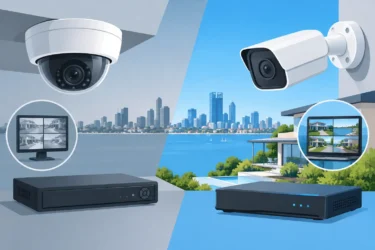
Modern CCTV is most effective when cameras are positioned for a purpose. External cameras can monitor approaches to the building, car parks, loading areas and perimeter gates. Internally, coverage may be appropriate at reception, corridors, point-of-sale areas, storerooms and access-controlled doors.
Image quality matters, but coverage design matters just as much. A high-resolution camera placed too high, pointed into glare or blocked by shelving may not identify a person when it counts. Low-light performance, wide dynamic range near glass doors and suitable camera angles should be assessed during design.
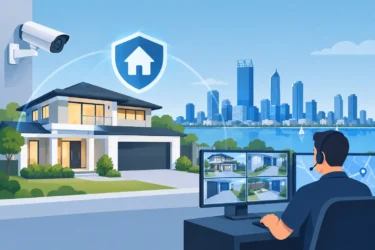
Remote viewing gives authorised managers the ability to check a site from a mobile device or computer, whether they are at another Perth location or away from the office. That convenience should be supported by secure user permissions, protected passwords and a properly configured recording system. Retention periods should reflect operational needs, available storage and any industry requirements.
CCTV is a strong deterrent, but it should not be treated as a substitute for physical security. Cameras record and help verify events. Access control, alarms, quality door hardware and good procedures reduce the opportunity for an incident to occur in the first place.
Access control that ends the key problem
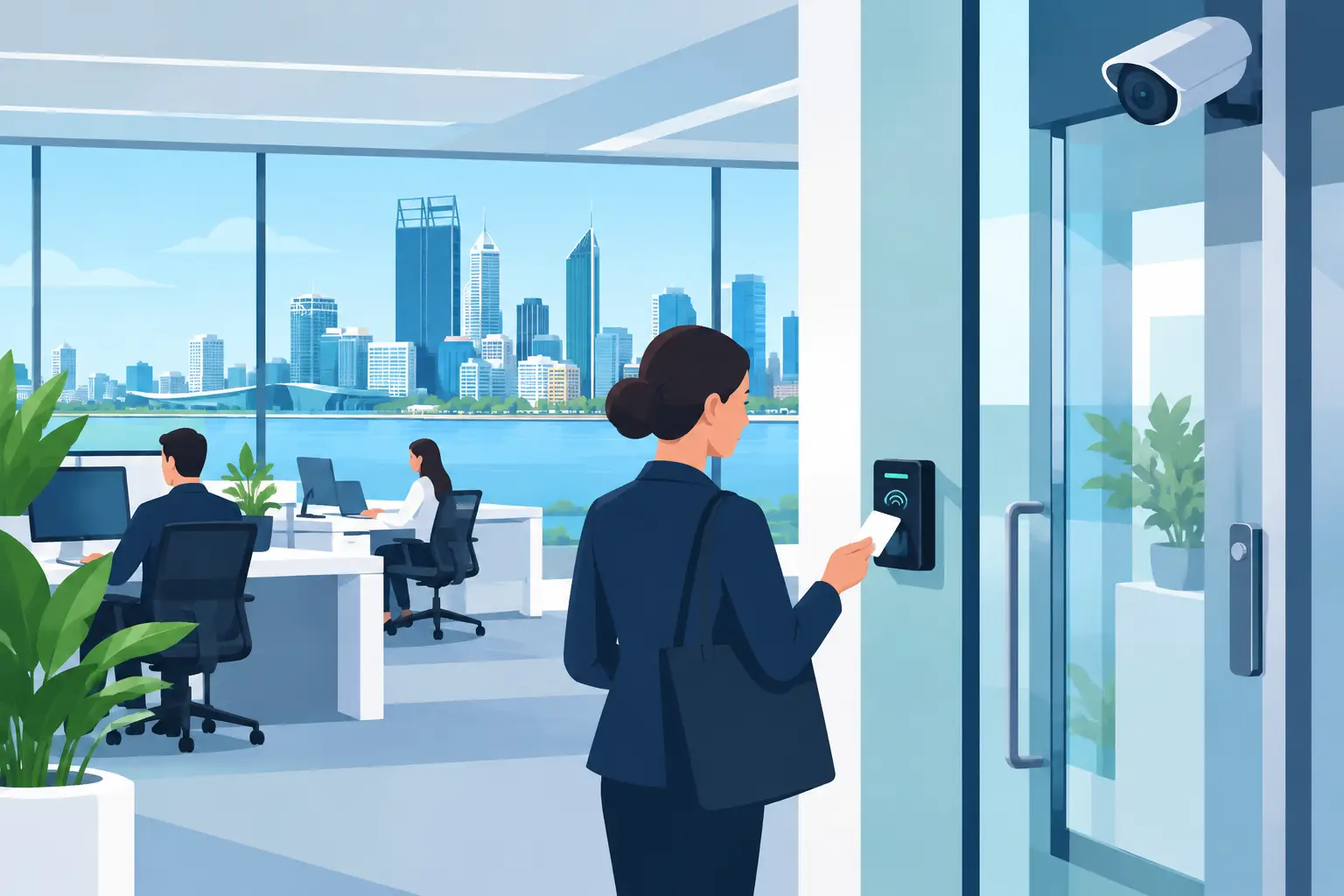
Replacing a master-key arrangement with electronic access control is often one of the most valuable office upgrades. Staff can enter using cards, fobs, PIN codes or mobile credentials, while managers can assign access by person, door, time and day.
If an employee leaves or a credential is lost, access can be removed without changing locks or collecting every key. Temporary credentials can be issued to contractors, and sensitive areas such as communications rooms or records storage can be limited to approved personnel. An audit trail can also show who accessed a door and when.
The right credential depends on the workplace. Cards and fobs are familiar and straightforward, while mobile access may suit businesses that want fewer physical credentials to manage. For high-risk areas, a combination of credential and PIN may be appropriate. The most secure option is not always the most suitable one if it slows legitimate work or encourages staff to prop doors open.
Intrusion alarms for after-hours protection
A professionally designed intrusion alarm provides another layer of protection when the office is unoccupied. Door contacts, motion detectors, glass-break detection and panic buttons can be selected and positioned according to the site layout and risk level.
Modern alarm systems can send notifications, support monitored response arrangements and integrate with other security equipment. For example, an alarm event can prompt relevant CCTV footage to be reviewed quickly. Proper zoning is particularly useful in offices with separate tenants, restricted rooms or staff working after hours, as one area can remain protected while another is in use.
False alarms are frustrating and costly, so installation quality and maintenance are essential. Detectors need correct placement, doors and windows need reliable contacts, and staff need clear instructions for arming and disarming the system. A system that people find confusing will not be used consistently.
Intercoms and visitor management at the front door
Reception is often where security and customer experience meet. Video intercoms allow staff to identify visitors before releasing a door, which is particularly useful where reception is not permanently staffed. They can also help prevent tailgating, where an unauthorised person follows an employee through a secure entry.
For larger offices, visitor management procedures can sit alongside electronic access. Visitors may sign in, wear identification and be escorted through controlled areas. This is not about making clients feel unwelcome. It is about giving staff a consistent, professional way to manage entry while protecting the workplace.
Make integration work for the way you operate
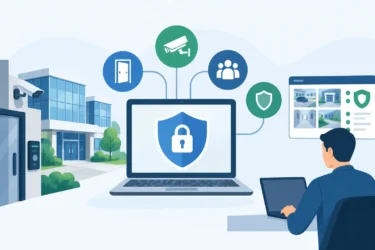
Standalone devices can solve isolated problems, but integrated office security upgrades can make daily management far simpler. CCTV, alarms, access control and intercoms can be designed to work together through a single, practical security environment.
Integration is especially valuable for businesses with several sites. Centralised visibility can help a manager oversee access activity and camera footage across offices, depots or retail locations without maintaining separate processes at each address. However, more integration is not automatically better. The system needs to remain understandable for the people who use it, and it must be specified around real operational requirements.
Network planning is part of this conversation. Security systems rely on stable connectivity, suitable network segmentation, secure remote access and backup power where required. An installer should work carefully with your IT arrangements rather than simply adding devices to an already congested network.
Do not overlook physical security and staff procedures
Electronic security is strongest when it supports sound physical measures. A door with an access reader still needs a suitable lock, door closer and frame. A camera covering a rear lane is more effective with adequate lighting. Secure storage, window protection and well-maintained perimeter gates may be just as important as the technology installed around them.
Staff practices complete the picture. Employees should know not to share credentials, hold secure doors open for unknown people or leave valuables visible near windows. They should understand how to report a lost fob, suspicious activity or a system fault promptly. Short, practical training at handover is more useful than a complex manual left in a drawer.
Privacy also requires thoughtful handling. Camera locations should be appropriate to the workplace and communicated clearly. Avoid recording areas where people reasonably expect privacy, and limit footage access to authorised personnel. Good security protects people without becoming intrusive.
Plan for maintenance before the system is installed
A security system is not a set-and-forget purchase. Cameras can become obscured, batteries degrade, firmware needs attention and building changes can create blind spots. A door that once secured a storeroom may later lead to a restricted finance area. Regular servicing keeps equipment reliable and gives you an opportunity to adapt the system as the business changes.
Before approving a proposal, ask what ongoing support looks like. You should know who will assist with faults, credential changes, camera adjustments and system expansion. It is also worth confirming whether your chosen system can grow with you, particularly if you expect to add staff, tenants or sites.
Securitec Security brings 30 years of experience to the design, installation and maintenance of tailored electronic security systems across Perth. A licensed, police-cleared team can help identify the measures that suit your site, budget and operational priorities, without adding technology that does not serve a clear purpose.
A considered upgrade gives staff confidence when they open up in the morning, work late or lock up at night. Start with the real risks in your office, invest in equipment that can be maintained properly, and build a security arrangement that remains dependable as your business grows.