
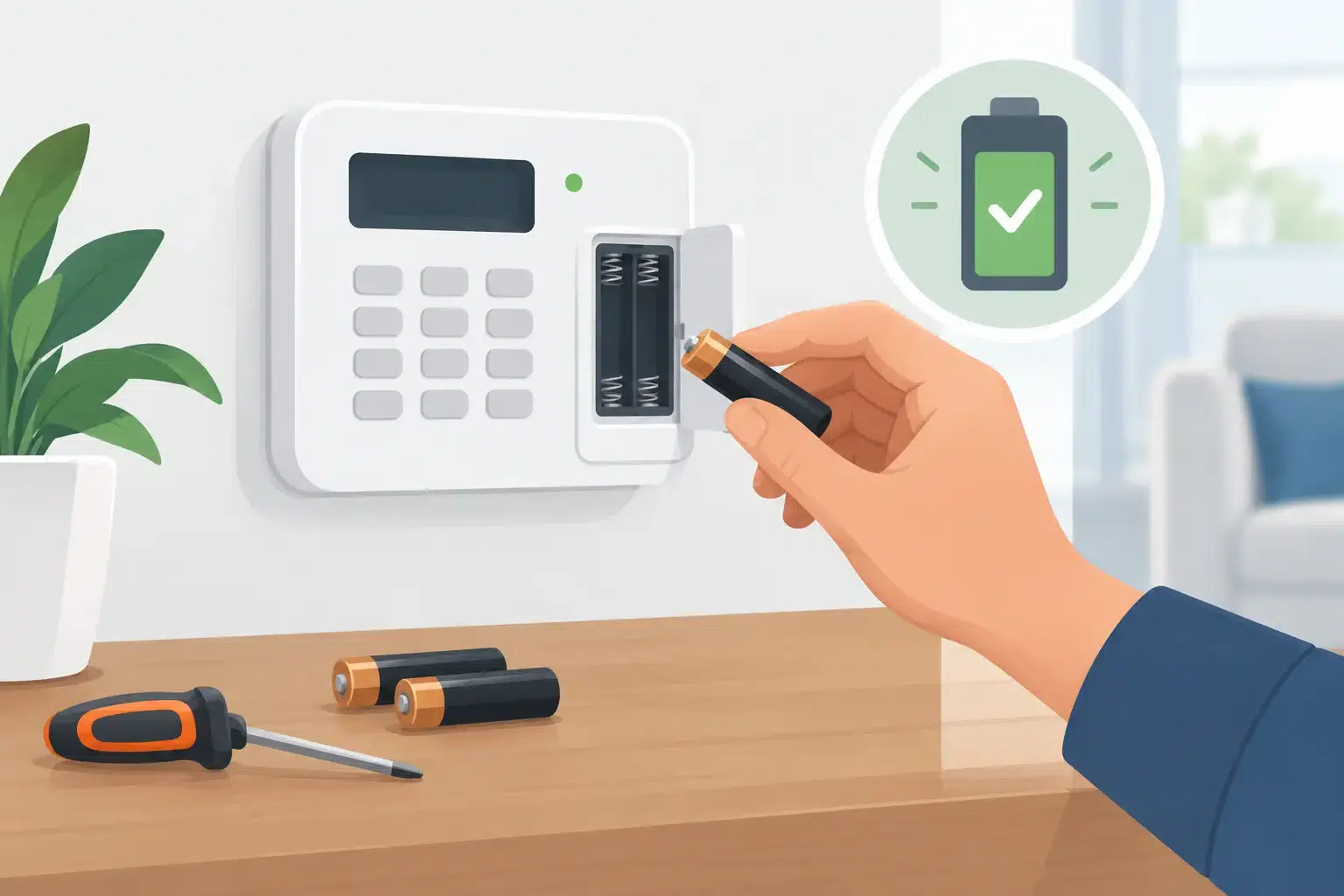
How to Test Alarm Battery Health at Home
A security alarm can appear to work perfectly while its backup battery is approaching the end of its service life. The panel may still power on, sensors may still respond, and the keypad may look normal – until a power outage reveals that the battery can no longer support the system. Knowing how to test alarm battery health helps you identify this risk early and keep your home or business protected when mains power is unavailable.
This guide covers the rechargeable backup battery inside an intrusion alarm control panel. It does not apply to the small replaceable batteries in smoke alarms, wireless remotes or standalone detectors, although those should also be checked as part of regular property maintenance.
Why your alarm backup battery matters
Most wired security alarms use a sealed lead-acid battery inside the control panel. During normal operation, the system runs from mains power and the panel keeps the battery charged. If there is a blackout, someone switches off power at the meter box, or the alarm wiring is damaged, the battery takes over.
A healthy battery gives the system time to continue monitoring doors, windows and detection devices, communicate an alarm event where applicable, and retain settings. The actual backup time depends on the battery capacity, the age of the battery, the number of devices connected and whether the system is reporting to monitoring.
For a homeowner, this may mean the alarm remains active through an evening outage. For a business, it can mean the difference between maintaining protection after closing time and discovering the panel has shut down without warning.
Signs your alarm battery needs attention
The most reliable early warning is a fault message at the keypad. Depending on the make and model, it may display a low battery, battery trouble, system fault or service message. Some systems beep periodically until the fault is acknowledged. Do not simply silence the keypad and forget it – the warning is there because the system has detected a condition that needs checking.
Other signs include a control panel that loses its date and time after an outage, an alarm that powers down quickly when mains power is removed, corrosion around battery terminals, a swollen battery case, or a battery that feels unusually warm. A battery older than three to five years also deserves closer attention, even if no warning has appeared.
Perth heat can shorten battery life, particularly where a panel is installed in a garage, storeroom, plant room or other poorly ventilated area. Dust, moisture and loose terminals can create problems as well. Age alone does not provide a definitive answer, but it is a sensible reason to arrange a proper test.
How to test alarm battery from the keypad
Start with the least intrusive check. Look at the keypad while the system is disarmed and review any displayed faults. Many modern alarm systems let you enter a user menu to view trouble conditions, battery status or service information. The exact menu path varies, so use the instructions for your model rather than guessing through programming options.
If the keypad reports a low battery fault, first confirm that mains power is available to the panel. Check whether other circuits are working and whether a breaker has tripped. A low battery message can occur because of an ageing battery, but it can also appear after a prolonged power interruption while the battery is recharging.
Once mains power has been restored, allow adequate time for charging before judging the result. If the fault remains after a day or so, or returns soon after being cleared, the battery is unlikely to be holding sufficient capacity. That is the point to book a service rather than repeatedly resetting the message.
Avoid testing your alarm by switching off power at the meter box without understanding how the system and any connected monitoring service will respond. Some systems will report a mains-fail event, activate a siren after a programmed delay, or create a callout if they are not placed into test mode first.
Inspect the battery safely
If you are comfortable accessing the panel and can do so without interfering with alarm programming, a visual inspection can provide useful information. Before opening it, disarm the system and notify your monitoring provider if your premises is monitored. The panel may have a tamper switch that creates an alarm condition when its cover is removed.
Inside, look for the rectangular backup battery, usually connected by red and black leads. Check that the terminals are firm and the leads are undamaged. Any bulging, cracking, leaking, strong chemical smell or white or green corrosion is a clear reason to stop and have the battery replaced.
Do not place tools across the terminals, and do not disconnect wires unless you know the correct shutdown and reconnection procedure for the panel. Even a small alarm battery can deliver a high current if shorted. It is also best not to leave the control panel open while you attend to other jobs around the property.
Use a multimeter only when you understand the limits
A multimeter can show battery voltage, but voltage alone does not prove that a battery is serviceable. A tired battery may show a normal-looking voltage when it has just been charging, then collapse under load during a blackout.
As a broad guide, a nominal 12-volt sealed lead-acid battery that has rested away from charging may read around 12.6 volts when fully charged. A reading well below that can indicate a discharged or failing battery. When connected to a live alarm panel, the reading may be higher because the panel is maintaining a charging voltage. The acceptable range depends on the panel and battery type, so manufacturer specifications take priority over a generic figure.
A professional technician tests more than voltage. They inspect the charging circuit, measure output where appropriate, assess the battery under load and confirm the system continues operating correctly on backup power. This matters on larger commercial installations, where multiple keypads, detectors, communicators, access-control equipment or external sirens may place greater demand on the backup supply.
Do not rely on a simple power-off test
It is tempting to turn off mains power and see whether the keypad stays on. While this can reveal an obvious failure, it is not a complete battery test. The system may initially appear normal, then lose power later when the battery voltage drops. You could also trigger communications faults, siren activity or a monitoring response.
Where a controlled backup test is appropriate, it should be planned. The premises should be disarmed, relevant people should know the work is occurring, and a monitored system should be placed in test mode. Afterward, confirm that mains power has been restored, the panel is charging, all covers are secure and no faults remain on the keypad.
For businesses, do not test during trading hours or when a power interruption could affect staff access, roller doors, communications equipment or other integrated systems. A tailored maintenance visit is generally the safer option.
When replacement is the better decision
Alarm batteries are consumable components, not lifetime parts. If the battery is several years old, has repeatedly generated faults, shows physical damage, or fails a load test, replacement is usually more cost-effective than trying to extend its life.
The replacement must match the panel’s required voltage, capacity, terminal type and physical fit. Installing a higher-capacity battery is not automatically an upgrade if the panel enclosure cannot accommodate it or the charging circuit is not designed for it. Likewise, fitting the wrong battery can lead to unreliable operation, charging faults or damage to the alarm system.
Dispose of the old battery responsibly. Sealed lead-acid batteries should be taken to an approved battery recycling collection point, not placed in household rubbish.
Make battery checks part of alarm maintenance
A practical approach is to check the keypad for faults monthly and arrange a professional alarm service at suitable intervals for the age, use and complexity of your system. Include the backup battery in every service discussion, especially before a holiday closure, after a lengthy blackout, or when taking over a property with an existing alarm.
For Perth homes and businesses, Securitec Security can assess battery condition as part of professional alarm servicing and identify related issues before they compromise your protection. A properly maintained alarm is easier to use, more dependable in an outage and far less likely to surprise you with a fault when you need it most.